The deal is signed. The wire has cleared. The founder shakes your hand, and everyone exhales.
Then Monday morning hits.
For most founders, this is uncharted territory. They have built a business from nothing, survived a grueling sale process, and chosen a partner they believe in. The first 100 days after closing will either validate that bet or make them regret it.
At Augeo Capital, we treat the first 100 days as load-bearing. The operational priorities matter — KPIs, reporting, hiring plan. But the human priorities matter more. How we communicate. How we disagree. How we earn the trust that makes the rest of it work.
The first week: Listen before you act
After closing, the temptation is to move fast. You have spent months in diligence. You have a thesis and a value creation plan. So you want to start executing.
We don’t.
The management team has been running this business for years. Sometimes decades. They know things about the customers, the operations, the culture — things no data room will ever contain. Our first job is to listen.
In the first week, we sit down with every key leader — not to present a plan, but to ask questions. What is working? What is broken? What keeps you up at night? What have you wanted to try but never had the resources or the air cover?
These conversations do two things at once. They surface insights that sharpen the value creation plan. And they signal something to the team: this partnership is going to be different. We are not here to impose a playbook. We are here to understand the business, then build with the people who run it.
Establishing the foundation: KPIs and financial visibility
Every business needs a dashboard. In the lower middle market, most don’t.
We regularly see companies reporting monthly financials 30 to 45 days after month-end. No forward-looking view. No cash flow forecast. No consistent set of metrics the leadership team reviews together. That is not a knock on anyone — it is the reality of businesses that grew on a founder’s instincts, not institutional process.
One of the first things we do is define the 8 to 12 key performance indicators that will govern the business. Revenue and margins, sure. But also backlog, customer retention, employee turnover, win rates, capacity utilization, cash conversion. The specifics depend on the business. The principle does not: you cannot manage what you cannot see.
We then install a reporting cadence. A weekly flash report on the metrics that move fast. A monthly financial close within 15 business days. A quarterly board package that tells the full story: where we are, where we are headed, what needs to change.
This is not surveillance. It is about giving the management team visibility they have never had. When the CEO can see customer churn ticking up in real time, or a key project slipping behind schedule, they make better calls. Reporting infrastructure is not a control mechanism. It is a leadership tool.
In most cases, this means supplementing the existing finance function. Many lower middle market companies have a capable bookkeeper or controller, but not a strategic CFO. Bringing in a finance leader who can build this is one of the first moves we make — and one of the highest-impact.
Defining the value creation plan — together
During diligence, we develop a working thesis on where the value sits. But a plan built in a conference room is not the same as a plan built with the people who have to execute it.
In the first 60 days, we work with the management team to narrow the value creation plan to two or three priority initiatives for the next 12 to 18 months. Not ten. Not five. Two or three that the team has the capacity to execute well and that will actually move the needle.
The themes tend to repeat. Formalizing a sales process that runs entirely through the founder’s Rolodex. Repricing products and services that have not been marked up since 2019. Fixing operational bottlenecks where the business has outgrown its systems. Building a pipeline of add-on acquisitions to accelerate growth.
Which initiatives we pick matters. How we pick them matters more. The plan gets debated, pressure-tested, and reworked with the management team until the people doing the work believe in it. A plan the team does not own is just a document. A plan they helped build is a commitment.
We also map the hiring plan for the next 12 to 18 months. Which roles need to exist that do not today? Where is the gap between the team we have and the team the plan requires? These are not theoretical questions. They come with names, timelines, and accountability.
Building the working relationship
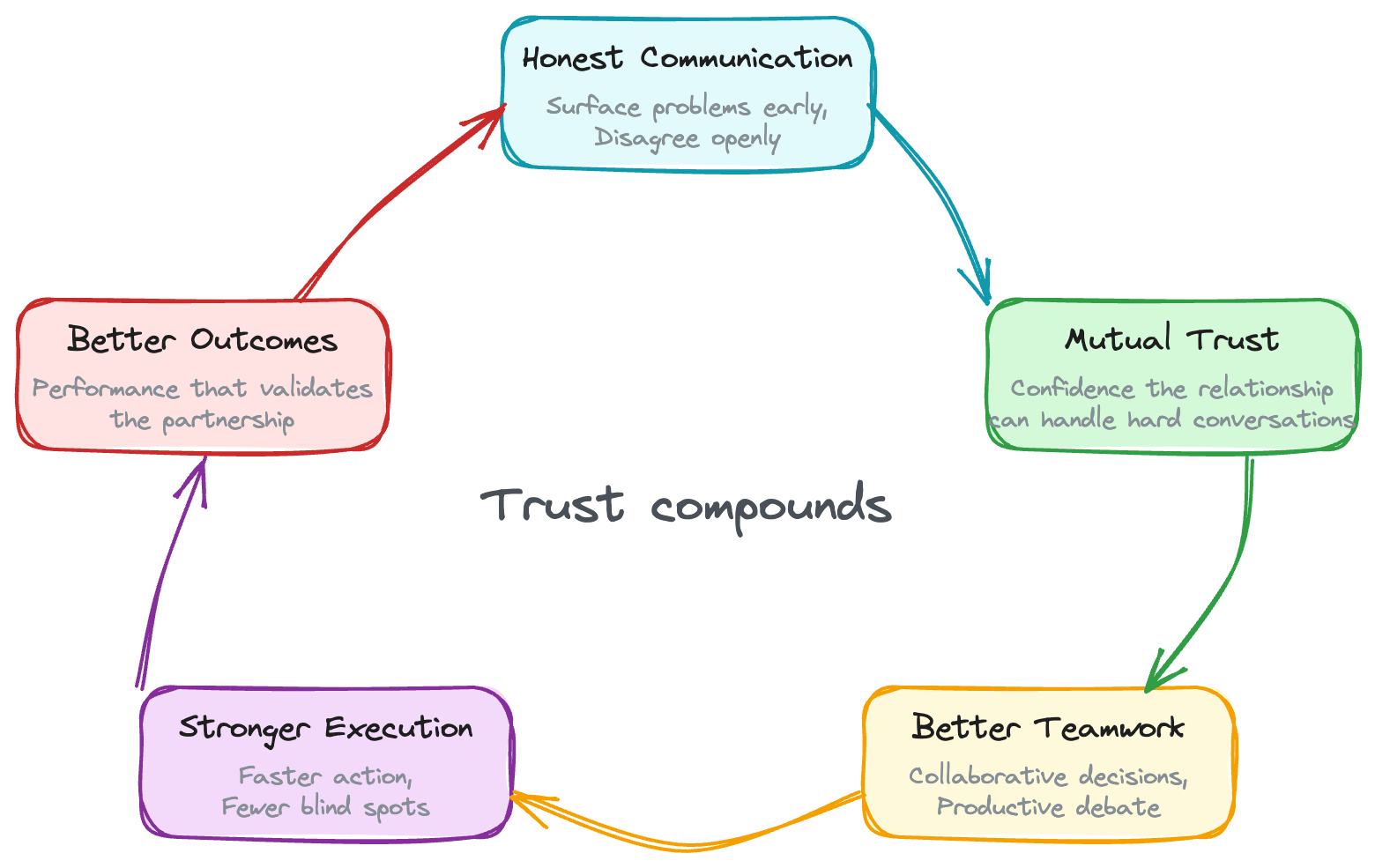
We spend as much time on this as on anything else in the first 100 days. Most private equity firms spend the least here.
The working relationship between sponsor and management team is not a soft factor. It is the operating system of the partnership. If the operating system does not work, nothing built on top of it will work either.
The first 100 days are when both sides figure out how to work together. That means setting a cadence: weekly check-ins, monthly operating reviews, quarterly strategy sessions. Communication should be regular and predictable — not reactive and crisis-driven.
It also means learning how to fight well.
In the early days, everyone avoids friction. The management team does not want to push back on the new owners. The sponsor does not want to seem heavy-handed. So everyone stays polite.
Politeness is not trust.
Trust is built when the management team raises a problem early — before it becomes a crisis — because they know the response will be problem-solving, not finger-pointing. Trust is built when we ask hard questions, not because we doubt the team, but because better questions lead to better calls. And trust is built when we disagree openly, work through it, and move forward.
We say this out loud from day one. Disagreement is not personal. Questions are not an indictment. Everyone at the table is working toward the same outcome. The quality of the decisions depends on whether people actually say what they think.
That takes practice. It takes time. It is also one of the most valuable things that comes out of the first 100 days.
The first 100 days are just the beginning
The first 100 days are not a phase with a clean endpoint. KPIs will evolve. The value creation plan will get reworked every quarter as the team learns what is working and what is not. Opportunities will surface that nobody saw during diligence.
The first 100 days do not produce a finished plan. They produce something harder to build and harder to fake: a team that knows how to work together, a shared language for decisions, and a foundation of trust that will get tested — and strengthened — over the years ahead.
A typical hold period runs four to seven years. That is sixteen to twenty-eight quarters of strategy sessions, operating reviews, tough calls, and course corrections. The cadence and the relationship built in the first 100 days carry the partnership through all of it.
The best first 100 days do not produce a perfect plan. They produce a team that trusts each other enough to adapt when the plan needs to change. That is worth more than any plan ever written.