Ask any experienced private equity investor what separates a great outcome from a mediocre one, and the answer almost always comes back to people. Not the financial model. Not the market timing. The people.
The data confirms what practitioners already know. According to Harvard Business Review, 69% of PE and portfolio company leaders cite talent as the most important factor for value creation — ahead of operating efficiency, organic growth, and financial engineering. Operational performance now accounts for twice as much value creation as deal-making and financing combined.
Yet most PE firms still spend far more time on the spreadsheet than on the people behind it. At Augeo Capital, we believe this is backward. Talent is not a soft topic. It is the highest-leverage bet we make.
Why talent matters more in the lower middle market
In large companies, the management infrastructure is already built. There are layers of leadership, established processes, and deep functional expertise across every department. If one executive leaves, the organization absorbs the shock.
Lower middle market companies are different. A $30 million business might have a founder who is the CEO, head of sales, and chief strategist — all at once. The bookkeeper handles the finances. Customer relationships live in two or three people’s heads. There is no VP of Sales, no HR leader, no operations executive, and often no management bench at all.
This is not a failing. It is the natural state of a business that has grown on the strength of a founder’s talent and relationships. But it means the management team is not just part of the asset — it often is the asset. And the gap between where the team is and where it needs to be is one of the largest sources of untapped value in the lower middle market.
PE firms retain the existing portfolio company CFO only about 25% of the time after closing a deal. That single data point tells you everything about the leadership gap in the companies we invest in.
The founder ceiling
Every founder hits a ceiling. Not because they lack ability, but because building a company and scaling a company require different skills.
The founder who grew the business from zero to $20 million did it through instinct, hustle, and personal relationships. They made every important decision. They knew every customer. They were the culture, the strategy, and the quality control — all in one person.
At some point, that same intensity becomes a constraint. The founder cannot delegate because no one else has the context. Sales stall because the pipeline depends on one person’s network. Financial reporting is months behind because there is no one to own it. The business is growing, but the infrastructure is not keeping up.
The numbers back this up. According to PwC and Bain research, 60 to 70% of PE-backed companies see a CEO change during ownership. Founder-to-CEO transitions fail at two to three times the rate of standard CEO successions. This does not mean founders are the problem. It means the role changes as the company scales, and the team around the founder needs to change with it.
Our goal is never to replace the founder for the sake of it. It is to build the team around them so the business is not dependent on any single person — including the person who built it.
How we assess talent before we invest
One of the most revealing findings in private equity research is what AlixPartners calls the 45-point perception gap: CEOs consistently rate the quality of their leadership teams far higher than their PE backers do. Only 10% of PE firms say portfolio company leadership gives them a competitive advantage, while 43% of portfolio company leaders believe their teams do.
This gap is why talent assessment is central to our diligence process, not an afterthought.
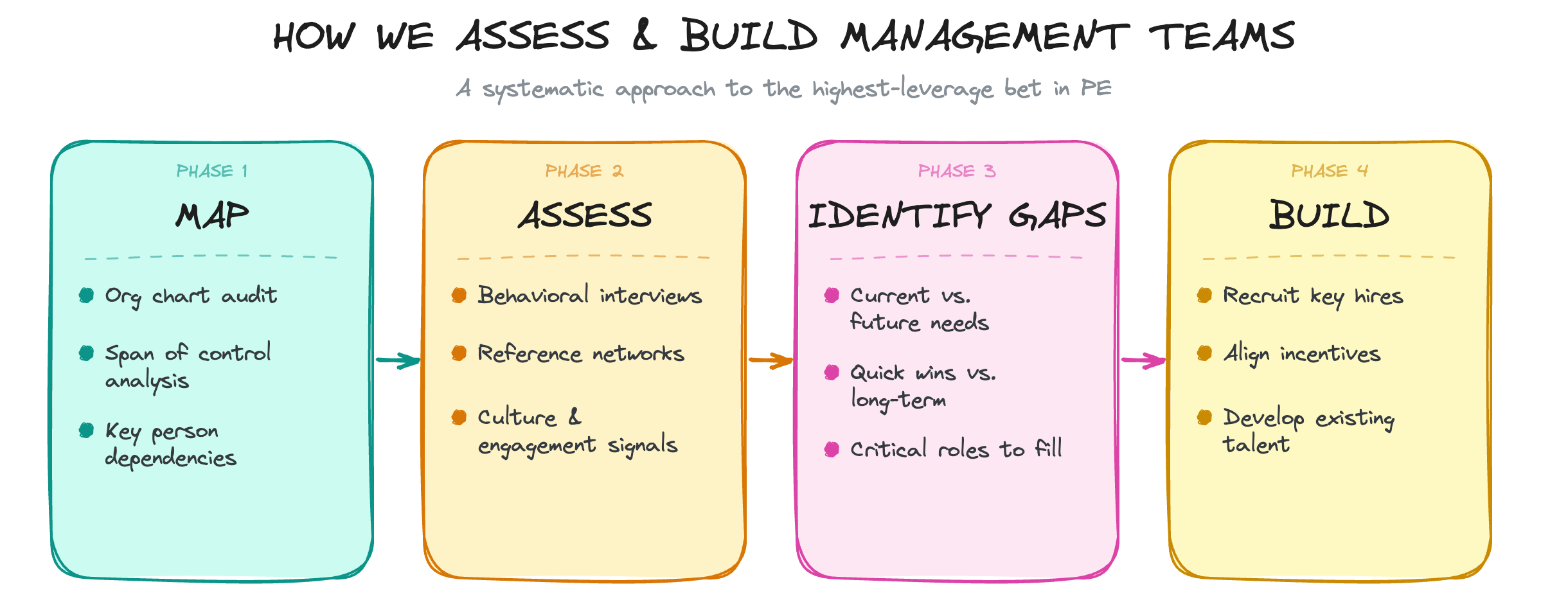
Before we invest, we go beyond the financials. We map the organizational structure and evaluate leadership capabilities against what the business will need over the next three to five years — not just what it needs today. We conduct behavioral interviews, check references across multiple dimensions, and look for the signals that matter most: self-awareness, coachability, and a genuine hunger to grow.
We are not looking for a perfect team. We are looking for a team that can become one — and for an honest understanding of where the gaps are, so we can move quickly after closing.
The quality of the management team is the single biggest predictor of whether an investment thesis will actually work. If the people cannot execute, nothing else matters.
The first 100 days
Speed matters. AlixPartners found that more than 90% of PE professionals say delaying talent decisions leads to missed value creation. McKinsey estimates poor integration execution destroys 30 to 50% of intended deal value. The first 100 days set the trajectory for the entire hold period. The goals and milestones set here span eight to twelve quarters.
Our approach starts with a rapid talent diagnostic. We assess every key leader against the capabilities the business needs to execute the value creation plan. We divide the findings into two categories: gaps we can address quickly and gaps that will take longer to fill.
The CFO seat is almost always the first upgrade. Most lower middle market companies have a bookkeeper or controller managing the finances — someone good at keeping the books but not equipped to be a strategic finance partner. Supplementing that role with a CFO who can build reporting infrastructure, manage cash flow with discipline, and provide the CEO with real-time visibility is one of the highest-impact moves we make.
From there, the priorities depend on the business, but common early hires include sales leadership, operations management, and a people or HR function. In many cases, these roles simply did not exist before.
Critically, we do not come in and gut the team. The institutional knowledge, customer relationships, and operational instincts that live inside the existing team are the asset. We assess, fill gaps, and build around the strengths that are already there.
Aligning incentives so everyone wins
The best management teams we have worked with share a common trait: they think and act like owners. The most reliable way to create that mindset is to make them actual owners.
Equity participation changes behavior. When the management team has a meaningful stake in the outcome, they make decisions differently. They think longer-term. They manage costs with more discipline. They push harder on growth because they share directly in the upside.
The typical structure in PE-backed companies reserves about 10-12% of total equity for the management team, with vesting tied to both time and performance — usually measured against return multiples (MOIC) or IRR hurdles. Some structures include co-investment alongside the sponsor, which further aligns interests and signals mutual commitment.
The impact is measurable. When KKR acquired GSI, they implemented exit-linked equity incentives across the management team. Employee turnover dropped from roughly 50% to 17% before exit. That is not a coincidence. When people see a clear path from their daily work to meaningful personal wealth creation, they stay and they perform.
At Augeo Capital, we structure every deal so the people running the business share in the value they create. This is not generosity — it is alignment. And alignment is the foundation of everything that follows.
The multiplier effect
Every other value creation lever — revenue growth, margin expansion, strategic acquisitions, technology upgrades — depends on having the right people to execute it. Strategy without execution is a slide deck. Execution without the right team is a grind that rarely ends well.
In the lower middle market, a single great hire can change everything. A VP of Sales who builds a real pipeline and a repeatable sales process. A CFO who gives the founder financial visibility they have never had. An operations leader who turns daily chaos into a scalable system. These are not small improvements. They are the moments a company breaks through.
This is the work we do at Augeo Capital. We identify great businesses that have outgrown their current team structure, partner with their founders, and build the leadership infrastructure that takes the company to its next stage of growth. It is hands-on, operationally intensive work. It takes judgment, relationships, and a willingness to be in the details.
We do it because it is where the returns live — and because there is no substitute for a great team.